Every request, whichever API it arrives on, passes through one gateway with the caller's own key.
The model servers are vLLM on DGX Sparks, each behind its own TLS, reachable only by the gateway
over a private network.
The path of a request
Your application calls https://llm.thalamusaicloud.com with its key: /v1/… for the OpenAI-compatible API, /api/… for the Ollama-compatible API.
The gateway (LiteLLM) checks the key, the models it may use and its limits, chooses a healthy backend that serves the model for your team, and records the request's usage.
The Ollama layer translates Ollama's API to the same gateway, passing your key through, so both APIs follow exactly the same rules.
The model server — vLLM on a DGX Spark, behind its own Caddy with TLS — answers, and the reply streams back the same way.
One hostname serves both APIs. Keys, model access, limits, routing, failover and usage live only in the gateway; the model servers never talk to applications.
Routing, failover and errors
A model can be served by more than one backend. The gateway probes each one and routes only to healthy backends that belong to your team's owner; when one stops answering it is taken out of routing, and requests go to the others.
503 model_unavailable with Retry-After — the model exists but no backend can serve it right now (stopped, starting, or unhealthy). It is not an application error: retry after the given time.
429 with Retry-After — your key, or the backend, is at its limit of requests in flight.
403 — your key may not use that model.
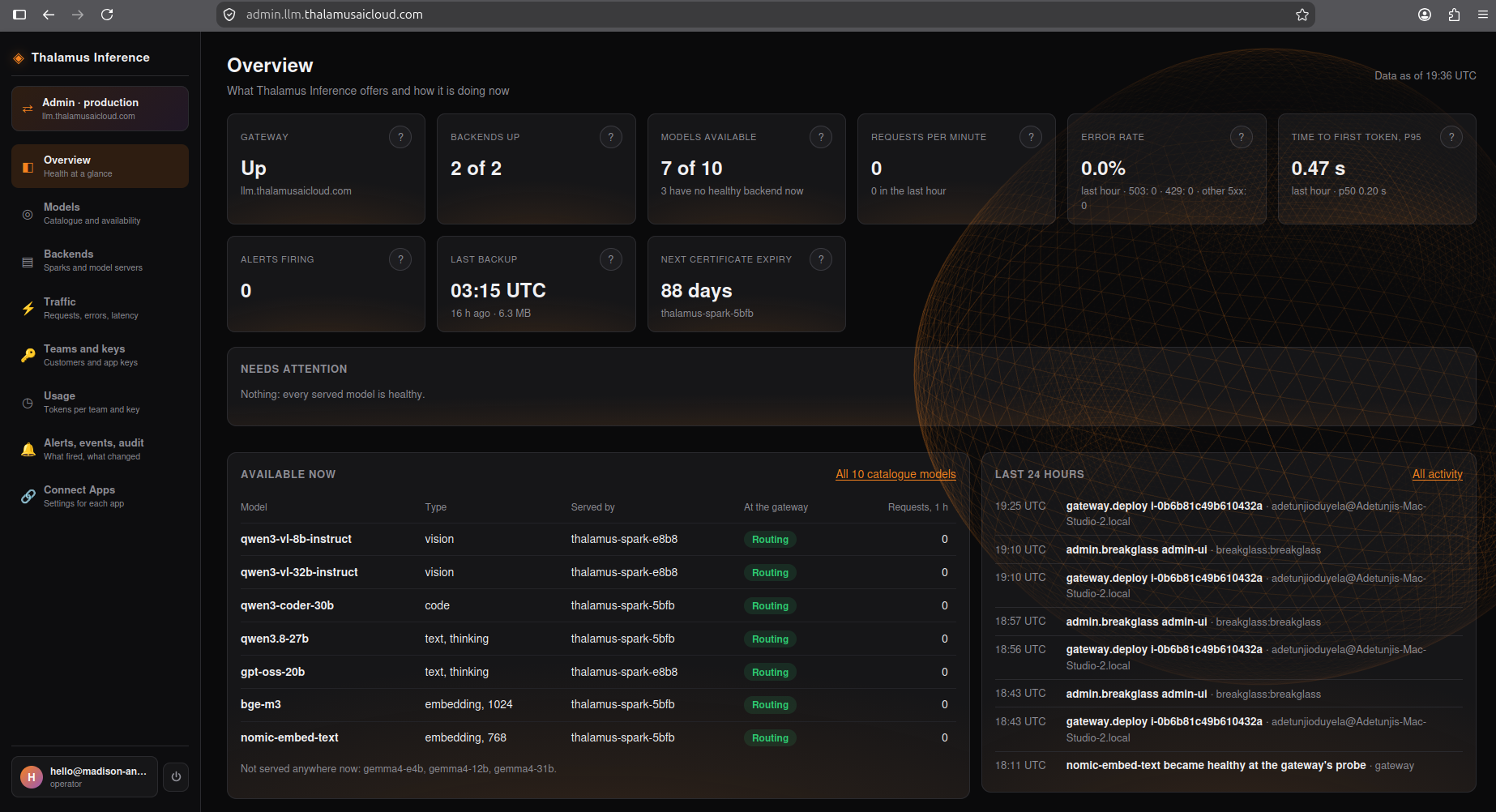
The Overview's Available now table and the Models page show which models are serving, and where.
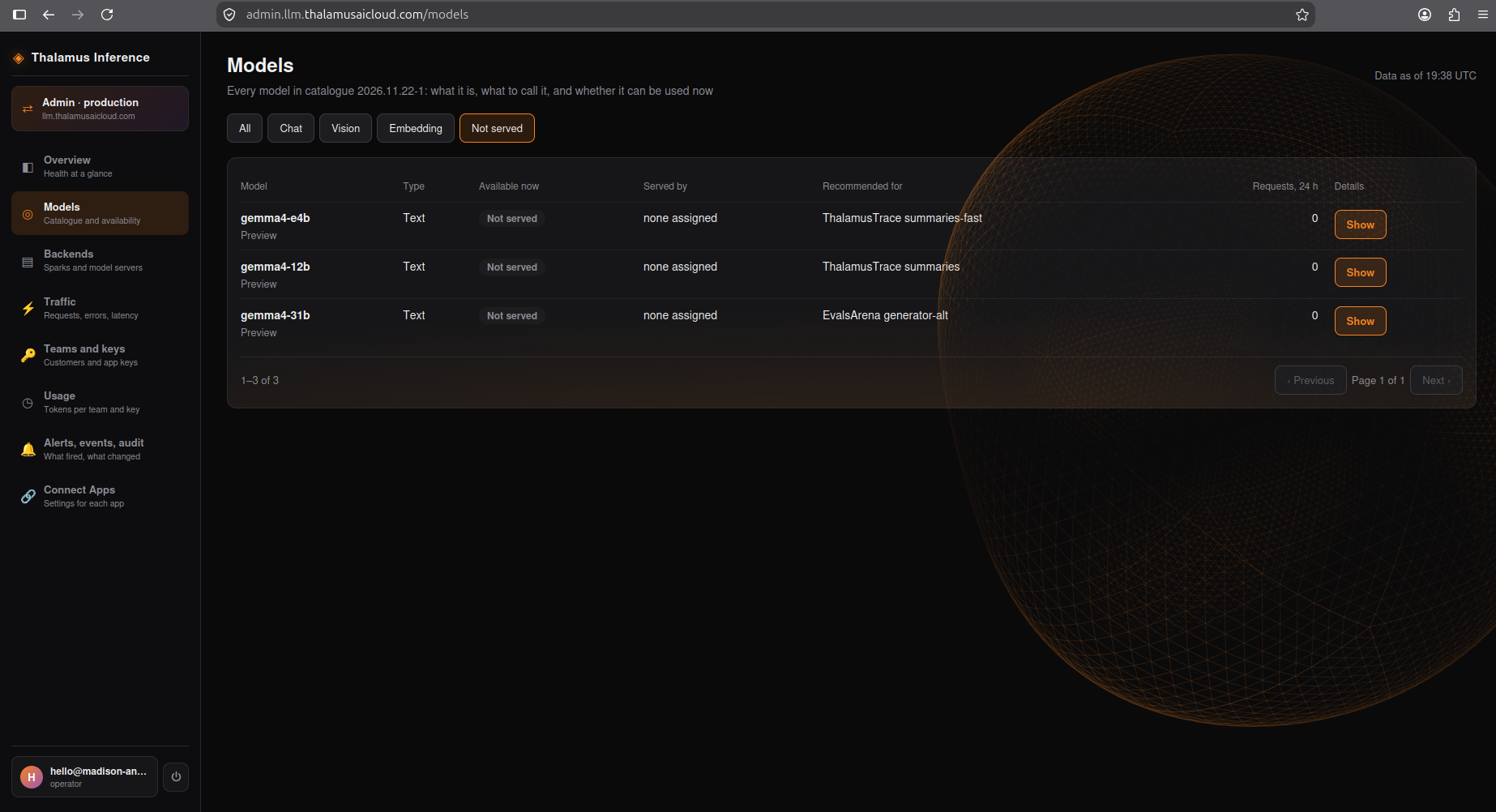
The Models page, Not served — catalogue models with no backend right now.
Start, stop and schedules
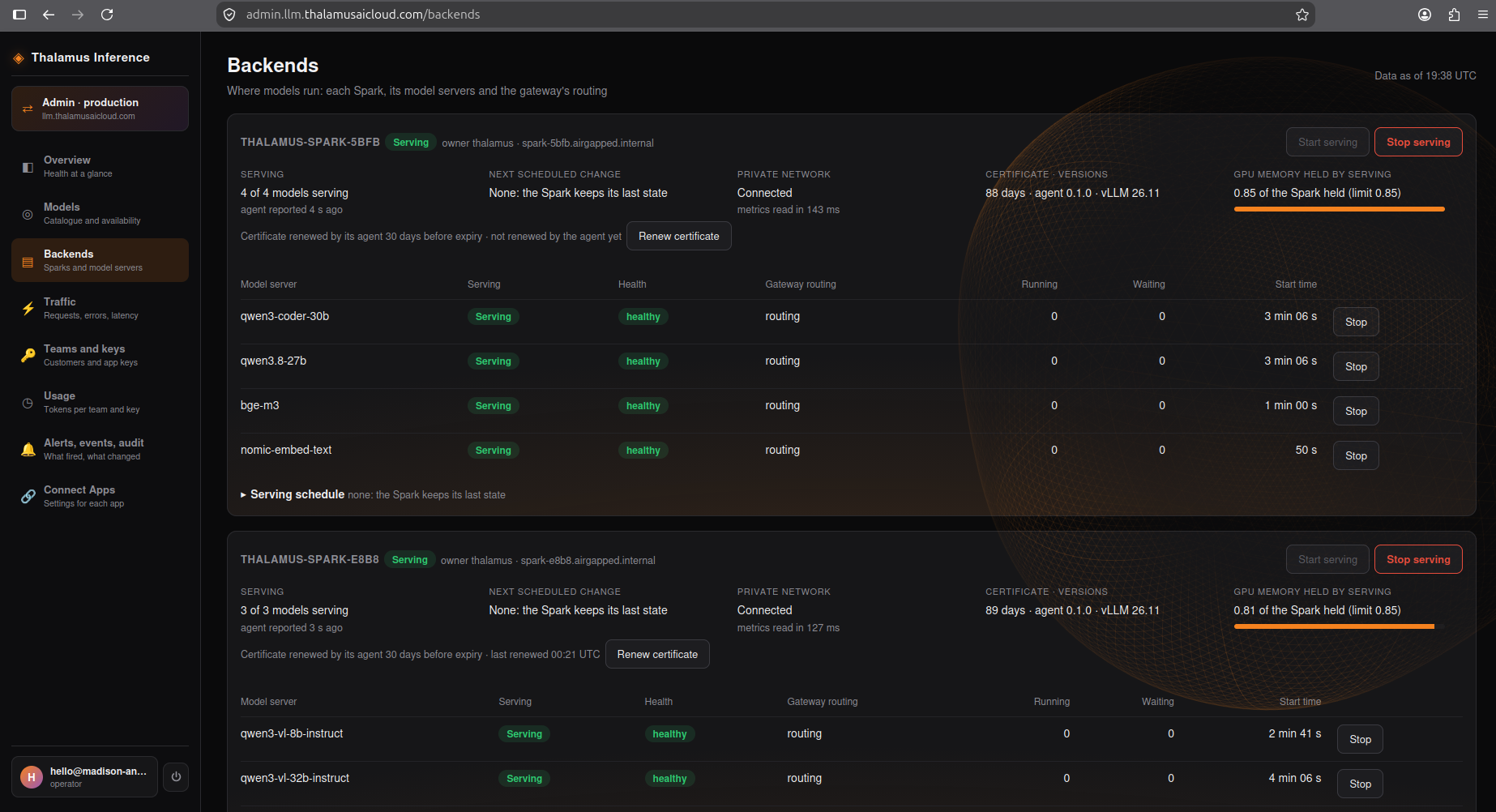
Each Thalamus Spark runs a serving agent. Operators start and stop a Spark's model servers, or a single model, from the Backends page, and can set a weekly schedule. The gateway takes a model out of routing before it stops and adds it back only once it has answered a test request, so callers see 503 model_unavailable with a retry time rather than failures.
The same agent renews each Spark's TLS certificate 30 days before it expires, with the private key never leaving the Spark.
Backends — serving state, the next scheduled change, the private network, certificate and GPU memory held by serving.
Model servers on DGX Sparks
Each model runs in its own vLLM server from a pinned image, with pinned weights. A Spark's memory is shared between its models by measured shares, never more than 0.85 of the Spark, so the models it holds always fit. Models start one at a time and are checked before they are routed.
Thalamus Sparks connect to the gateway over a private WireGuard network coordinated by Headscale, with TLS on top; customer Sparks in their own networks follow in a later phase.
What is stored, and what is not
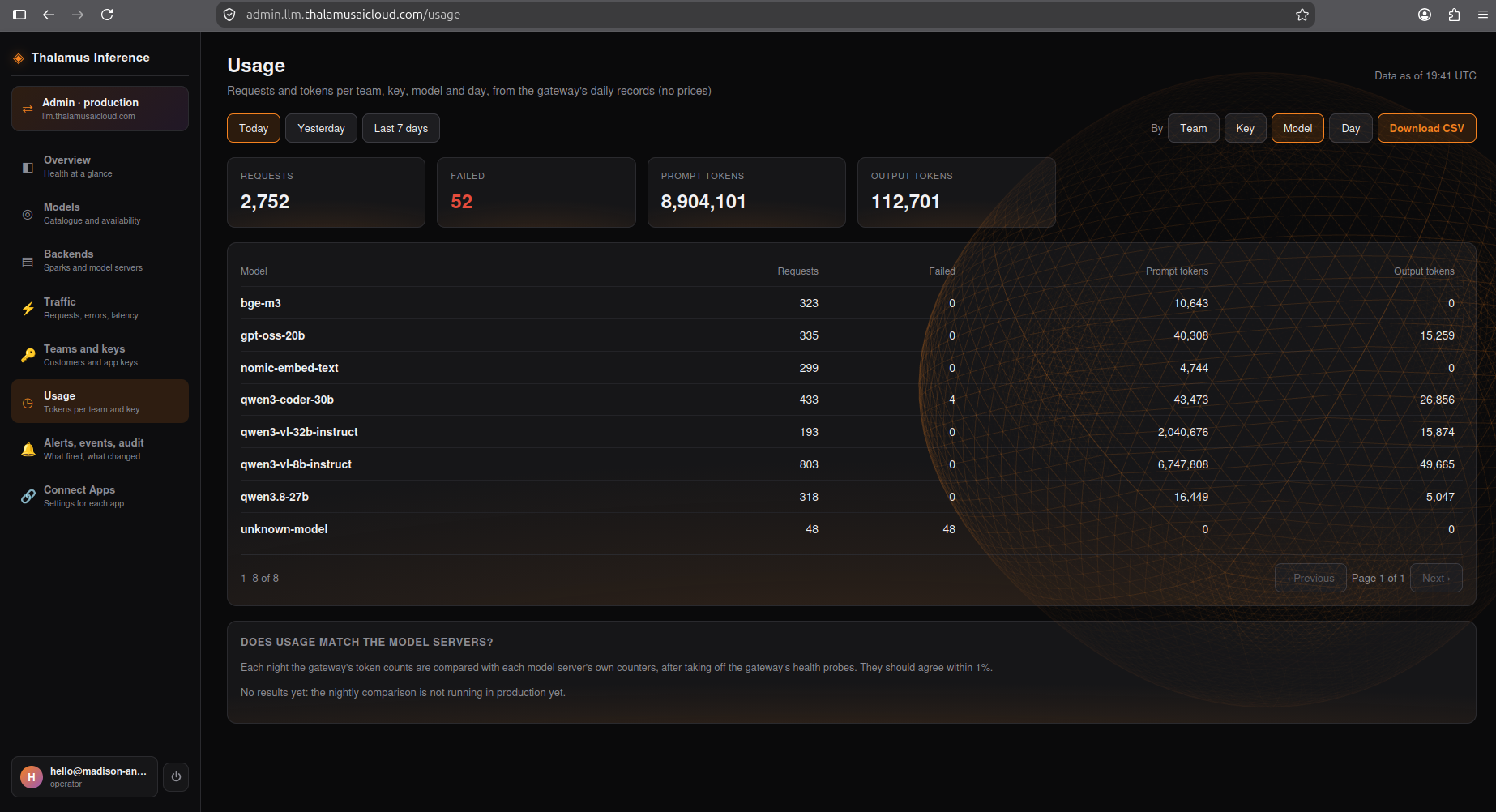
Stored: keys (as hashes), teams, and usage — requests, failures and token counts per key, model and day.
Never stored: prompts, images and replies. They are not written to disk or to any log, in the gateway or on the Sparks; a test plants marked requests and searches every log and file for them.
Each night the gateway's token counts are compared with each model server's own counters, after the gateway's health probes are taken off; they should agree within 1%.
Usage by model — requests and tokens from the gateway's daily records.
Schedule a demo
Run your models on your terms
Tell us about your applications and the models they need, and we'll show
you how Thalamus Inference would serve them: on Thalamus DGX Sparks, or on hardware in your
own network, behind one gateway with your own keys and usage.
A walkthrough of the gateway, the models and the Admin console
Which of your applications connect by configuration alone
Sizing: which models fit on which Spark, and what they serve